About St Francis Cottage

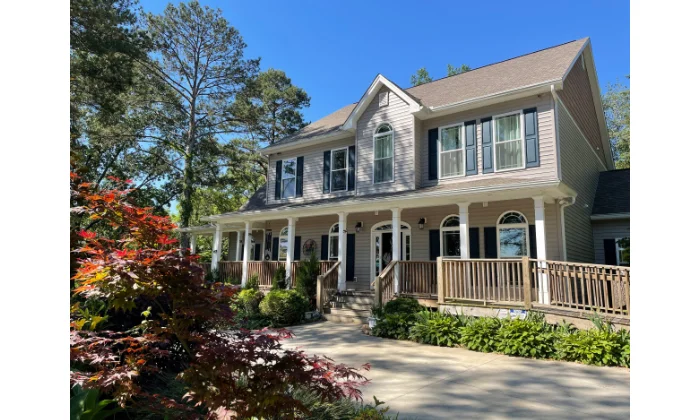
St Francis Cottage Exterior
In 1993, the Brauds purchased the 4.5-acre remnant of the old Glenn Farm one mile east of Interstate 75 in the East Brainerd suburb of Chattanooga, Tennessee. The old farm house, barn, and acreage were a wonderful fun haven for their family, affectionately called "The Farm." Fifteen years later, another acre was added after the last of the neighboring Walker Farm was sold by its heirs to a local developer. This area along Mackey Branch was historically known as Tulsa Creek of the Opelika Settlement, which was inhabited by the Cherokee until the mandated removal in the late 1830's.

"Several notable Cherokee made their homes in the East Brainerd-Graysville area, among them one of the Fields brothers and Alexander McCoy, secretary of the National Committee. The farms were strung out mostly along Mackey Branch, which they called Tulsa Creek.

We have been told that the original structure was a two-room house built prior to the civil war, however, we have been unable to confirm that information. Local deed records indicate that our property was part of the J.T. Phillips Tract from the 1800's, who conveyed to Charles Dudley in 1909, then to the Boyds in 1924, who then sold to the Glenn Family in 1944. Pre-Civil War and Civil war artifacts were found in the cistern under the original house by prior owners. While renovating the kitchen, the original stone hearth was discoverd, and an ancient rattlesnake skin was found while removing the old fireplace!  Over the past 30 years, the area has explode with commercial development, so the aim is to preserve and nurture the 75 to 100 plus-year old oak, pine, cherry, locust and black walnut trees that help create the peaceful atmosphere at St Francis Cottage.

Additional trees trees, shrubs, and perennials, have been cultivated along with thorn-less blackberries, Gogi berries, strawberries, figs, pears, Muscadine grapes, asparagus, garlic, and the usual summer vegetable garden of tomatoes, squash, cucumbers, beans, peppers and herbs. In order to preserve the integrity of the original Cherokee-occupied lands, we use virtually no chemical fertilizers, herbicides or pesticides in any of our gardens. The desire is to share this land and the gardens with others. Construction on St Francis Cottage began from the ground up in mid=2016 on 2.3 of the 5.5 acres,


St. Francis Cottage has been created to provide a private, serene setting from which guests can venture out to enjoy the many splendors of the beautiful Scenic City and the surrounding area. Each guest will be treated with the kind of attention that is reserved for family. When our guests arrive, we want them to leave their troubles at the door and step into a world of comfort and rest in an urban cottage setting. Our aim is to enhance the elements of a well-lived life through genuine hospitality, restful rooms, nourishing and delicious food and engaging conversation among our visitors. As owners, we intend to see that attention to detail and service are dedicated to each and every person. We have found that people live more fully when connected to the wonders of nature, so we continue to develop our herb, vegetable and flower gardens throughout the property. At St. Francis Cottage, we embrace enthusiasm, creativity, nature and community.
placeholder

Tennessee Green!

In an effort to support the preservation of the environment, our operating practices conform with the guidelines of the Tennessee Hospitality and Tourism Association's Tennessee Green Hospitality program. Below are some of the ways that we're helping the environment in the Tennessee Valley:

* All plastic that is recyclable within Hamilton County along with aluminum/glass/paper are recycled.
* We do not use Styrofoam.
* New dual-flush toilets requiring lower water consumption are utilized in order to save many gallons of water each day.
* A highly energy-efficient HVAC system includes individual thermostats in each guest room.
* Energy-efficient LED light bulbs are used throughout the Cottage.
* Ceiling fans are installed throughout the Cottage to help regulate temperatures and comfort.
* Cleaning solutions and laundry detergent are non-toxic and made on-site from natural ingredients, when possible.
* Our washers and dryers are high-efficiency models, using less water and electricity and include steam sanitizing.
* We encourage guests to re-use towels and have their sheets changed only as needed.
* Many of our amenities are organic, and we use eco-friendly linens and towels for guest rooms.
* Whenever possible, we buy local and organic food.
* We support local plant sales and incorporate historic and native plants into our landscaping. We use organic fertilizers and do not use chemical pesticides or herbicides in any of our gardens.